Military world building: how special operations happen.
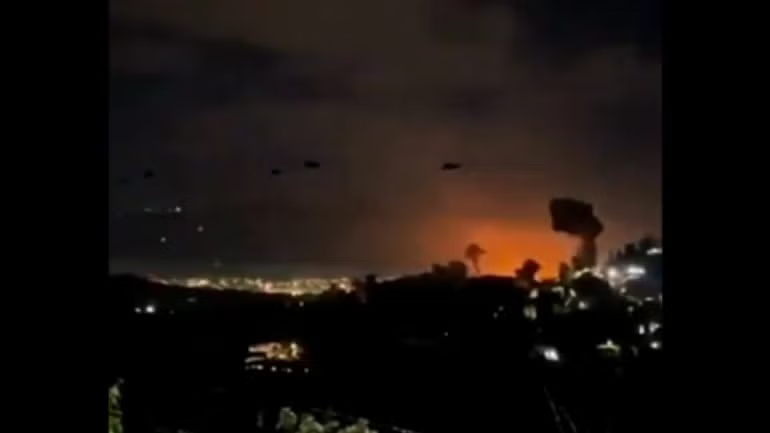
Unless you’ve spent the last week under a rock you’ll have seen that the US Delta Force captured Venezuela’s dictator/president Nicolás Maduro on the morning of Saturday 3rd January in an audacious special operation1.
I’m not here to comment on the long-term wisdom of this action, and I definitely won’t talk about the legality, or otherwise, of it. But I do want to talk about how military professionals (and Delta Force are among the best in the world) make things like this happen. It’s an additional rebuttal of the military lone wolf fallacy which we see in Hollywood, and which I’ve discussed here before. I also want to help prospective military worldbuilders to get some idea of the amount of time, energy, and preparation which goes into an operation like this. It’s a glimpse, in other words, of how the sausage is made.
Firstly, I’m going to talk about the capabilities that the US has compared with other militaries. Then I’ll discuss some of the universal principles of successful special operations. In particular, I’ll focus on simplicity in the planning phase, constant rehearsal in the preparation phase, and clarity of purpose in the execution.
Update: We should mention the fact that, as of 8th Jan, there have been 55 combatant and 2 civilian deaths on the Venezuelan side. This doesn’t take away from the “success” of the operation from a military point of view, but it should swiftly disprove any idea that this is somehow bloodless or harmless. Imagine, for a moment, that there were 57 deaths on the American side.
Update 2: If you want more detail on this operation, The Rest is Classified discussed this in detail a few days after the operation. Worth a listen.
Before we start, let me encourage you to subscribe to the blog using the link below. As always, I’d love to see your comments below, or you can contact me via webform here or email here. Finally, if you’ve enjoyed this post, please share it with a friend.
If you enjoy this blog and want to support it, please consider a donation. Keeping this blog going doesn’t cost much, but it isn’t free either, so any help would be very much appreciated👍
Capability matters, but some principles are universal
The United States has the greatest military in world history. This brings a few advantages when you’re trying to abduct a president from his palace. For example, floating the world’s largest aircraft carrier and largest ever warship off the coast is a useful way to carry out airstrikes on the enemy’s key defences (with some of the most advanced planes in the world) before sending in the operators.
Speaking of operators, another enviable capability is an amphibious assault ship like the USS Iwo Jima which can bring the special forces teams and their helicopters close in to shore. The helis2 themselves, as seen below, are (you guessed it) among the best in the world:

When planning the operation, it helps to have high-ranking insiders who can tell you about your target’s routine. Then, when the helis are in the air, it’s useful to have the cyber capabilities to switch off the enemy’s power grid for the duration of the assault.
These factors are all very important, and we shouldn’t ignore them, but a successful special operation is about much more than raw power and capability. If military strength was the only determining factor, then Putin ought to have been easily able to capture Ukrainian president Volodymyr Zelenskyy on 24th February 2022.
Special operations such as capturing or killing an enemy leader rely on six important principles for their success. These are: Simplicity, Security, Repetition, Surprise, Speed, and Purpose. Some of these are “traditional” principles of war, like we discussed here before, but others are specific to special operations.
They were identified by Admiral William H. McRaven in his book Spec Ops. This is the guy who planned the Bin Laden raid in 20113, so he knows whereof he speaks:

We don’t have time to go through all of these principles, but I’d like to focus on three important areas next: simplicity in planning, repetition in preparation, and a sense of purpose in execution.
Eternal pessimism of the military mind
To the untrained eye, a military pre-mission briefing (“orders” session, or “O-Group”) lacks the pizazz and rhetoric you might expect based on Hollywood:

O-Groups are long, detailed, and can be extremely dull. It’s not about giving rousing speeches, but about making sure every person in the team knows what they need to do (as well as what everyone else needs to do—more on this below).
The most detailed and often the dullest parts of the O-Group are two of the most important:
- The scheme of manoeuvre, where the commander breaks the plan down into detailed phases. This is usually done at a large-scale map or 3D terrain model which, in turn, has been based on detailed reconnaissance. Unlike in the movies, where the commander waves their hands vaguely at a flashy screen, this gets detailed. Painfully so. The team will go over each phase again and again, with different people asked to “read it back to me” just to make sure they get it.
- The actions on, where the commander and team talk through the contingency plan for what might go wrong at every phase of the plan. What if we get lost during the infiltration? Or get seen on the final target approach? What if someone falls and breaks their leg? Or a vehicle breaks down? What about two? What about three?
The extreme level of detail, especially for actions on, can seem like an exercise in extreme pessimism. Most vehicles, even military ones, don’t break down from A to B. But this “train hard, fight easy” mentality is crucial for successful operations.
As we saw above, simplicity is a principle of special operations as well as of war more generally. No military operation, at least not a successful one, will be any more complicated than it absolutely needs to be. Every cog in the wheel of the operation should be conceptually and physically simple:
- Complexity comes from the interaction of many simple parts
- Chaos comes from the interaction of many complicated parts
This is something which Hollywood often gets wrong, thinking that military success comes from making and executing plans which are smarter and more complicated than your enemy’s.
When I see the epic but ridiculously complicated plans in films like The Dark Knight (vanilla Joker’s plan as well as Bane’s plan in the sequel); The Mission: Impossible films or (gulp) Tenet, I think of this salutary lesson from The Simpsons on complicated plans:
In reality, military success comes from doing simple things well, because, as the legendary Clausewitz said:
Everything is very simple in war, but the simplest thing is difficult
How do special operations forces manage to overcome the friction of war and execute the “simple” but difficult things in hostile conditions? It’s simple: with repetition.
Practice makes near-perfect
Moving from the planning phase to the preparation phase, the key principle to discuss here is repetition. To repeat: moving from the planning phase to the preparation phase, the key principle to discuss here is repetition4.
I was surprised, when I first cut my teeth as a young cadet, to see the amount of time dedicated to rehearsals. After an O-Group, it was not unusual to spend nearly as long again bumbling through our actions on a halt, or what to do if we come into contact5, or even simple things like where we leave our heavy bags when we get to the final rendezvous and go in for the close reconnaissance (recce6) on target.
“A good set of rehearsals can save a poor set of orders,” as our instructors told us again and again. Being clueless trainees, we delivered many poor sets of orders. I’m not sure that our rehearsals were much better, but that’s almost the point. You make your silly mistakes in a “safe space” and learn for the real event.
If “rehearsals” sounds very theatrical and maybe even a bit foppish, then you’re on the right track7. Just like actors will do a table read and work their way up to a full dress rehearsal, soldiers will start with a “walk-through talk-through” and work up to a full (maybe live) dress rehearsal of the operation.
Special operations take this idea, like everything they do, all the way up to eleven.

The teams which carried out the Maduro raid built a full-scale replica of his presidential compound which they could practice their drills in. This isn’t surprising in the slightest. Given the stakes involved and the time they had to prepare, you’d be shocked if they didn’t go to this level of effort.
Special operations teams will go through rehearsals again and again until the actions they need to take are a muscle memory. They will practice scenarios where various curveballs are thrown in, so they can also practice the endless “actions on” which were in their orders. It’s in the rehearsals, and dealing with the known unknowns, that the team will gel and become the sort of resilient and flexible fighting force which can do operations like this. Like all fighting forces, they rely on team effort. Let’s talk about this next.
Specialists, generalists, and a conspicuous lack of action heroes
A special operations forces (SOF) friend of mine tells me that special ops are “1/3 operator and 2/3 enabler.” Enablers are the folks who ensure that the operators are able to kick in that door and seize or shoot that high value target when it presents.
This has three implications. The first is obvious: no lone wolf heroes need apply. I’ve written about this before, so won’t labour the point here.

The second is that capabilities matter, as we’ve discussed above. The third is that every person in that team, be they an “operator” or an “enabler” needs to know their purpose for being there.
McRaven defines “purpose” as:
The understanding of the mission’s objectives and a personal commitment to see those objectives achieved.
The first part of that, the understanding, comes from the extensive planning and preparation which I’ve discussed already. The second part comes from the high motivation and morale which would be expected in highly skilled teams like this.
A third part which I think ties into all this is the idea of redundancy: if everyone knows what the purpose is, and everyone is sufficiently trained and rehearsed with overlapping skillsets, then the team is less reliant on any single individual for mission success:

This redundancy wouldn’t work without everyone on the team having a sense of purpose, and without the seamless interaction and cross-pollination between the operators, enablers, and all the other elements which come together to make a successful operation like Absolute Resolve.
Conclusion: Now for the hard part
There’s a lot more that goes into a successful special operation. It’s not possible to boil it down in a short article, but I hope this gives you some insight into the realities of how a special operation comes together successfully.
I’m not speaking ex cathera on this topic, since I don’t have SOF experience, but I’m grateful to those who have and who gave their time graciously and generously to answer my questions about this and point me in the direction of William McRaven.
I do have to mention, before finishing, that there are theories out there that this was all an inside job, with government officials in Venezuela selling out Maduro and promising not to oppose the US operation. While it seems pretty clear there was inside help, I’m not sure I buy the theory that it was all an inside job. For starters, there are lots of people who would need to play along. I would be more inclined to attribute the lack of armed resistance to the impeccable planning, detailed preparation, and flawless execution (with no small amount of luck) by the US forces.
In any case, this is a fluid situation and time may well prove me wrong on the above point. Even if it was an inside job, however, you can bet your ass that the special operations teams which took part trained for and treated it just like a “live” operation. Because, for all they knew, it was.
One last point before I finish: impressive and all as this military operation was, it’s only the beginning for the US and the people of Venezuela. As Johan Vanderplaetse put it on LinkedIn:

War may be “politics with other means” (thanks again Carl), but by adhering to the principles of special operations, these small and self-contained acts of war can be made as predictable and effective as possible. Politics, of course, will never be so easy.
A final (really this time) note, just for a laugh: here’s what WordPress AI generated automatically as a cover image for the article:

Thanks for reading and please remember, if you haven’t already, to subscribe using the link below. Please also share this article with a friend and help me get even better reach in 2026! See you next week.
Cover picture: From @realDonaldTrump/Truth Social
- Operation Absolute Resolve, if you like your hoo-rah ‘murican nomenclature. ↩︎
- Or helos, if you’re that way inclined. ↩︎
- And made the famous “First, make your bed,” speech. Useful if you need a bit of motivation. ↩︎
- I’m really sorry, but I couldn’t resist this stupid gag. ↩︎
- Come under fire. ↩︎
- Or “recon.” Again, whatever floats your boat. ↩︎
- To be fair: a bunch of men put on face paint and special outfits and have to hit their marks just like a chorus line: the world of drag would be impressed. ↩︎


Leave a Reply to High altitude, high supply – Military Realism ReportCancel reply