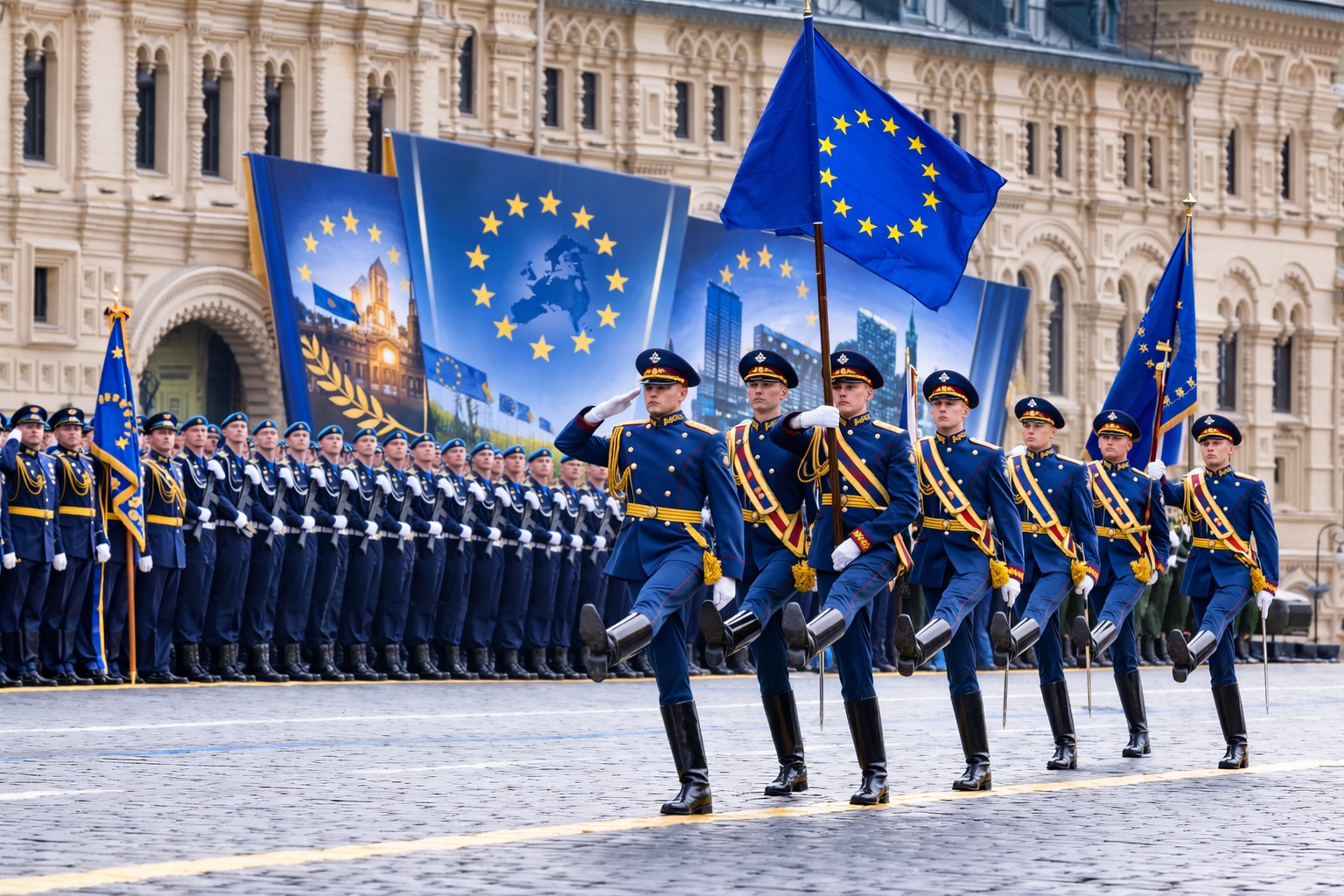
Why the EU doesn’t have its own military force… for now.
🎧 Available in audio
Hi there. This week I want to talk about EU military capabilities—or lack thereof. My wife was wondering aloud why the EU doesn’t have an army to “fix a few things.” Most Irish people would instinctively recoil in horror at the idea, but she’s originally North American, and so isn’t afraid of military things. Which is/was good for me, I suppose.
Anyway, her question got me thinking (as usual) about the history and possible future trajectories of the EU. And although it seems natural to me that it doesn’t have an army, I suppose I should explain for the benefit of my non-European readers. I’ll also speculate wildly (the only kind of speculation I do) about whether I see a future EU army.
I’m going to move on from that to talk about the army that Europe—not the EU—does have, which, of course, is NATO. And you can’t talk about NATO without talking about the USA, so I’ll discuss the history of the US military too and see if we can draw any parallels with Europe.
This topic is current because Europe is rapidly re-militarising to face the Russian threat, while the USA’s historically ironclad support for NATO is rusting. It seems unlikely to repair itself any time soon, despite Ireland’s best intentions with the upcoming EU Presidency.
What would General Hastings Ismay, NATO’s first Secretary General, say if he could see the alliance today? He was the first to describe NATO as an organisation designed to:
Keep the Russians out, the Americans in, and the Germans down.
Unfortunately for his legacy, by this logic NATO is now failing on all three levels. Is it time to think about an EU army?
A quick note on terminology: when I say “army,” I’m talking about “military forces” or “the military,” as it’s become a noun in recent decades (thank you America). When people talk about an “EU army” in everyday conversation they are including air forces, naval forces, cyber, space, and any other emerging domains that fall under the umbrella of “military.” Apologies to my readers in light or dark blue; I am perhaps perpetuating a land-centric view of things. Write me a letter in the comments if you think this is intolerable.
I’m also going to be loose enough with my terminology when it comes to “Europe” and “the EU.” This is because there are many different and overlapping definitions of “Europe.” I’ll clarify what I mean when it matters, but I won’t stick to one rigid definition. More often than not I’ll be talking about the European Union, or EU, which you can find among the tangled web of relationships below:

Before we start, let me encourage you to subscribe to the blog using the link below. As always, I’d love to see your comments below, or you can contact me via webform here or email here. Finally, if you’ve enjoyed this post, please share it with a friend.
If you enjoy this blog and want to support it, please consider a donation. Keeping this blog going doesn’t cost much, but it isn’t free either, so any help would be very much appreciated👍
There’s no EU army, despite many people being in favour
Let’s get the basic facts out of the way first. The EU does not have an army (or an air force, or a navy). There are no troops wearing an EU uniform, with the EU flag on their shoulder, getting paid by Europe, swearing allegiance to Europe, standing to attention for the Ode to Joy, etc.
There are many aspects of EU collaboration and cooperation on military matters. Critics of EU militarisation and/or EU federalism often point to one or more of these as evidence of an EU military, or at least an EU military ambition. The first is not true, but the second probably is. Let’s look at some of these:
- CSDP. The EU’s Common Security and Defence Policy is the overarching framework for everything else.
- PESCO, or PErmanent Structured COoperation, is an aspect of the CSDP which allows EU member states to offer capabilities to a central “pot” if they reach a certain acceptable bar. Think of it like NATO but with much looser entry criteria.
- EUMS. The EU Military Staff are part of the governance structure of PESCO. They command the troops which are pooled by member states for a common mission, i.e. the EU battlegroups, were they ever to be deployed.
- EDA. The European Defence Agency encourages and enables the kind of cooperation between member states which is governed by PESCO and CSDP.
- EU battlegroups. A “battle group” is a battalion plus the necessary support elements it needs to operate independently. It’s the smallest viable deployable force: a military MVP. EU battlegroups have been around since 2007 but have yet to be deployed anywhere.
- EU-mandated missions such as Operation Sophia (combatting people traffickers and rescuing refugees in the Mediterranean) and EUFOR Tchad/RCA to protect civilians and UN workers and ensure the delivery of humanitarian aid in Chad and the Central African Republic.
That’s a lot of “stuff” going for something that isn’t an army. How can we be sure that it isn’t one? There’s a handy metric you can use, and that’s to ask the question: who has command of the troops?

Even the EU battlegroup, if it was deployed, would be hard to view as an “EU army,” and not just because of its size. The troops would still be wearing the uniforms and carrying the weapons and equipment of their home countries. They would be controlled by the EU for the duration of the mission but their final allegiance would be to their own country’s chain of command.
This is exactly that same model that the United Nations uses for its peacekeeping operations. Peacekeepers wear the blue helmet but their own uniform and national flag on their shoulder. Their primary command and control structures are with their home base, with a consent-based international command and control structure as part of the UN force headquarters. The military staff who make up this command structure are also drawn from an international pool of expertise which is usually in rough proportion to the number of troops contributed (jobs for the boys ∝ skin in the game).
Plenty of EU federalists would like to see an EU army and have no hesitation in saying as much. Common defence policy (which we can broadly take to mean the measures described above) has an overwhelming ~80% support among polled EU citizens, and that figure has been unchanged for decades. On the more direct question of an EU army, recent polling shows ~55% of respondents in favour and ~30% opposed.
In the next two subsections, I’ll dive into the two big reasons why the EU doesn’t have an army.
This is because of what the EU is…
If you’re like me, you might have only a vague idea that the EU is a recent phenomenon. There were a bunch of treaties in the early 2000s (which Ireland in particular was instrumental in holding up) and it used to have more of a “community” vibe, but it still seems relatively fixed and eternal, bar the occasional Brexit2 here or accession there.
Forgive my ignorance, for this may not be news to you, but the EU is younger than I am. It was born with the Maastricht Treaty of 1992 and didn’t come of age until the Lisbon Treaty of 2007. I remember the second of these, of course, but I didn’t actually understand its political implications at the time. Perhaps it was because I was in deep in the hurt locker of my own military induction. Or perhaps it’s because the simplest timeline of European integration looks like this:

There’s a lot to take in there, including NATO, which we’ll get to below. What’s important for our purposes is the purple bit toward the bottom, the Common Foreign and Security Policy. This includes the CSDP which we mentioned above, and was one of three pillars of the proto-European Union3, the others being justice (the yellow one) and the economy (greenish).
The point of this mind-bending timeline is to show you that European common foreign (and defence) policy is just over thirty years old. And sure, you could argue that that’s plenty of time for a “country” to develop an armed force. My own country (Ireland) had an army even before it became a country, for obvious historical reasons.
But the EU is not a country. What is it, then? I’m going to borrow (and slightly extend) Martin Sustrik‘s analogy from his excellent “EU explained in 10 minutes” article. The EU is a stereotypical house in the Balkans (or parts of the Middle East, where I saw plenty like this):

The top floor is unfinished and the roof has rebar sticking out. Why on Earth would you do that? There are two very good reasons, both analogous to how the EU works:
- Reason 1: Change is hard, so you lock in what you can. In a precarious economy with inflation, it makes sense to spend money when you can on something tangible, rather than saving up for one big project. So, you build one floor at a time and leave the infrastructure there to build another floor at a later date, when you have the next influx of capital. Political and institutional change is hard, so the EU locks in what it can while leaving unwieldy but useful provisions in place for future expansion.
- Reason 2: You pay less (or no) tax on an unfinished house. Even if you have all the space you and your family will need, there may be excellent tax reasons to avoid topping out your building. In a similar way, the EU’s permanently unfinished nature gives everyone a useful “out” clause when they need it.
The EU is not a country in the way that Britain or China or France is. It’s not even a country in the way that the USA, the archetypal federation, is. The EU is a confederation, albeit one with a strong drive toward federalism. More like e pluribus plus than e pluribus unum.
Progress toward an EU army over the last 30 years has definitely happened, but it’s always constrained by the simple reality that Europe already has an army. Let’s discuss that next.
…and because it already has a powerful army
The North Atlantic Treaty Organisation (NATO) dates from 1949. It has 32 member states, of whom 23 are members of the EU (out of 27 EU members in total). The diagram below shows the relationship:

NATO is not an army in itself, but it’s a damn sight closer to having one than the EU is. It has a much deeper and more developed command and control structure which has undergone decades of testing and refinement throughout the Cold War. Its member states train together and jump through extensive hoops to achieve interoperability. Most importantly, however, they can muster 3.5 million soldiers and account for over half of the world’s expenditure on defence (NATO spends close to $1.5 trillion on defence as of 2024, if you’re wondering).
The non-EU elephant in the NATO room is the United States, which alone accounts for two thirds of NATO’s defence spending. Britain is the other notable non-EU member, since it has its own nuclear deterrent. Canada, Norway, and Iceland round out the non- and probably never-EU members. These countries (along with Denmark, through Greenland) form the defensive ring around the Russian threat:

In the interest of balance, I should note that the defensive ring formed by NATO might look very different if you were watching from Russia and had their history of being on the receiving end of invasions. Not that that excuses their culpability and crimes in the Russo-Ukrainian War, it’s just an observation.
How do NATO and the EU integrate with each other? It’s complicated by those pesky countries who insist on being awkward and not sitting in both camps4, but one model comes from the attempt in the 1950s to establish a European army via the so-called European Defence Community. This was an agreement between France, Italy, West Germany, Belgium, The Netherlands, and Luxembourg to join forces as a single unified European arm of NATO. The treaty was never ratified by Italy or France, so the idea has been on hold ever since.
There are two important caveats to note before we finish talking about NATO. The first is that, as I mentioned above, it’s not an army. It’s an international organisation. It does lots of things which enable and facilitate large armies to operate together, but it does not in itself make an army.
When troops deploy with a NATO mission, their primary command and control structure remains their own national hierarchies. On multinational operations this leads to a complex matrix of “national caveats,” or things which troops from a particular country can’t do. These can, for example, limit where troops from a certain country can operate or what rules of engagement they can be subject to.
The July 2014 issue of the NATO Legal Gazette (.pdf link) has a discussion paper from Thomas E. Randall, a legal advisor for NATO military leadership. He provides the following (and you could substitute “army” for “nations”):

Randall describes the limitations that national caveats place on NATO commanders. In particular, he notes that:
One of the most extraordinary examples, however, is a caveat previously imposed by two NATO nations, perhaps without benefit of sufficient common-sense review by operators. It indicated that close air support could not be provided to friendly troops in enemy contact in situations where the forward air controller was from a nation that had not ratified Additional Protocol I to the Geneva Conventions!
I mean, that must be annoying to American commanders, since the USA is one of three countries (along with Iran and Pakistan) who haven’t ratified this protocol which deals with the protection of civilians.
I’m being snide, I know, but the point is that NATO is not an army. The second big caveat is that the USA, the non-EU elephant in the room, is showing an alarming ambivalence toward NATO ever since President Donal Trump returned to the White House in 2025. It’s not all about Trump, however. The Americans were lamenting the one-sided nature of NATO for over a decade, with President Obama calling the European members of NATO “free riders.” Remember when comments like that seemed controversial?
Undoubtedly, however, President Trump’s recent threat to annex Greenland has been the sharp kick in the backside that European leaders never wanted to get, but sorely need. Mutterings about a European army are starting again. Could it ever happen?
Could the EU ever have an army?
The evolution of the US Army holds lessons for Europe. Today the US military is one of the largest in the world with 1.3 million active duty soldiers, sailors, aircrew, and marines (only China and India have more troops). The US Army, i.e. the land component (yes, I’m using terminology properly now), is undoubtedly one of the largest and most capable armies on the planet. But it was not always like this.
Remember we talked about how the EU is more like a club of individual, sovereign countries than a single unified entity? Well, that’s exactly what the United States was like in its beginning. It took nearly a hundred years and one brutal Civil War before Americans stopped referring to their country in the plural form (e.g. saying: “this United States is…” instead of “these United States are…”).
Power rested with the states to an extent that is hard to comprehend today, and people’s identities were much more strongly aligned with their state than with the supposed nation. Robert E. Lee, the famous Confederate general, opposed secession and was ambivalent about slavery, but fought for the Confederate side to defend Virginia, his home state, from the Union Army5.
On the Union side, 97% of soldiers who fought for the North were state volunteers as opposed to federal troops. Even today roughly a third of the US Army’s million-man strength “belongs” to the states through the Army National Guard.
The US military became the leviathan it is today not in an instant, but over successive challenges in the nation’s history, from the War of 1812 to the Cold War and even the “global war of terrorism” (GWOT) which spawned the largest and most capable special operations force the world has ever seen6.
How far must Europe travel? Quite a distance. McKinsey compared the militaries of the US and Europe to highlight the multiplicity of types of weapons systems, vehicle platforms, ships, and aircraft which Europe must deal with:

The underlying message is clear: Europe should pool its military resources and be more like the US. But how feasible is this? Let’s wrap up with that question.
Conclusion: Make me capable, but not yet
European armies have been ‘hollowed out’ and been described as ‘bonsai armies’: they look like the real thing but have shrunk into miniature versions.
—Josep Borrell, former Foreign Affairs and Security Chief of the EU (27th Aug 2022, via European Union External Action)
Europe’s problem is that the whole is less than the sum of its parts. This is the fault of member states, but it also reflects decades of learned reliance (and therefore helplessness) as part of NATO’s structures.
In the once unthinkable but increasingly likely scenario of Europe having to ensure its own defence, how do the numbers stack up?
Here’s what the current NATO vs. Russia balance of military power looks like. I could take any number of metrics, but I’ve chosen three: number of active duty personnel, total military spending7, and number of nuclear weapons:

The result is a clear slam-dunk for NATO on two out of three categories, with a slight disadvantage when it comes to nukes. As I wrote a few weeks ago, however, this number of nukes is still more than enough. One caveat when it comes to spending, however, is purchasing power parity: Russia’s €150 billion goes a lot further, relatively, than NATO’s €1.4 trillion.
Now let’s take North America out of the picture and see what we’re left with. I’ve shown two options: the EU27 by itself themselves8, and a more optimistic scenario where the UK and Norway are part of European defence:

In this scenario the match-up in terms of economics and manpower is much closer, but the Russians blow Europe clean out of the water (possibly literally) with their overwhelming nuclear advantage. You might think that 300 or 500 nukes is still “plenty”, and it’s definitely a credible deterrent, but falls short as a strategic tool in light of Russia’s numbers.
Will Europe ever have to face this challenge? It all depends, at least in the medium term, on what happens with NATO.
Stuart Dowell wrote a piece recently in TVP World arguing that a European army isn’t on the cards any time soon. He’s probably right. His reasoning is based on NATO: why would national governments duplicate the structures of NATO in a parallel EU defence framework? Why do this when NATO still exists as a perfectly good alternative?
He argues that:
Much of the EU’s history is built on the idea of “spillover,” first articulated in the 1950s by Ernst Haas, a German-American political scientist who argued that European integration would advance through crises as states were pushed to transfer more powers to the center to keep earlier compromises from collapsing. Integrate one area of policy and pressure builds to integrate the next, because partial integration creates new problems that only deeper integration can fix. In practice, this has meant Europe repeatedly “failing forward.”
It will take a few more ratchets or instances of “failing forward” before we see a fully-fledged European army. And it may never happen, if the threat from Russia recedes or America rediscovers its role as the world police (or at least the Europe police).
But the author of the above piece does foresee a reality based on Polish foreign minister Radosław Sikorski’s idea of a “Euro Legion.” This would be a brigade-sized force funded directly from the EU’s coffers. If this happens, then it’s another definitive ratchet, a step up from the EU Battlegroups.
As similar federations on a similar scale have taught us, the centre does not give up power once it’s been gained, and military forces are the ultimate form of power.
Will there ever be an EU army? Watch this space… but don’t hold your breath.
Thanks for reading and please remember, if you haven’t already, to subscribe using the link below. Please also share this article with a friend and help me broaden my reach. Every little helps! See you next week.
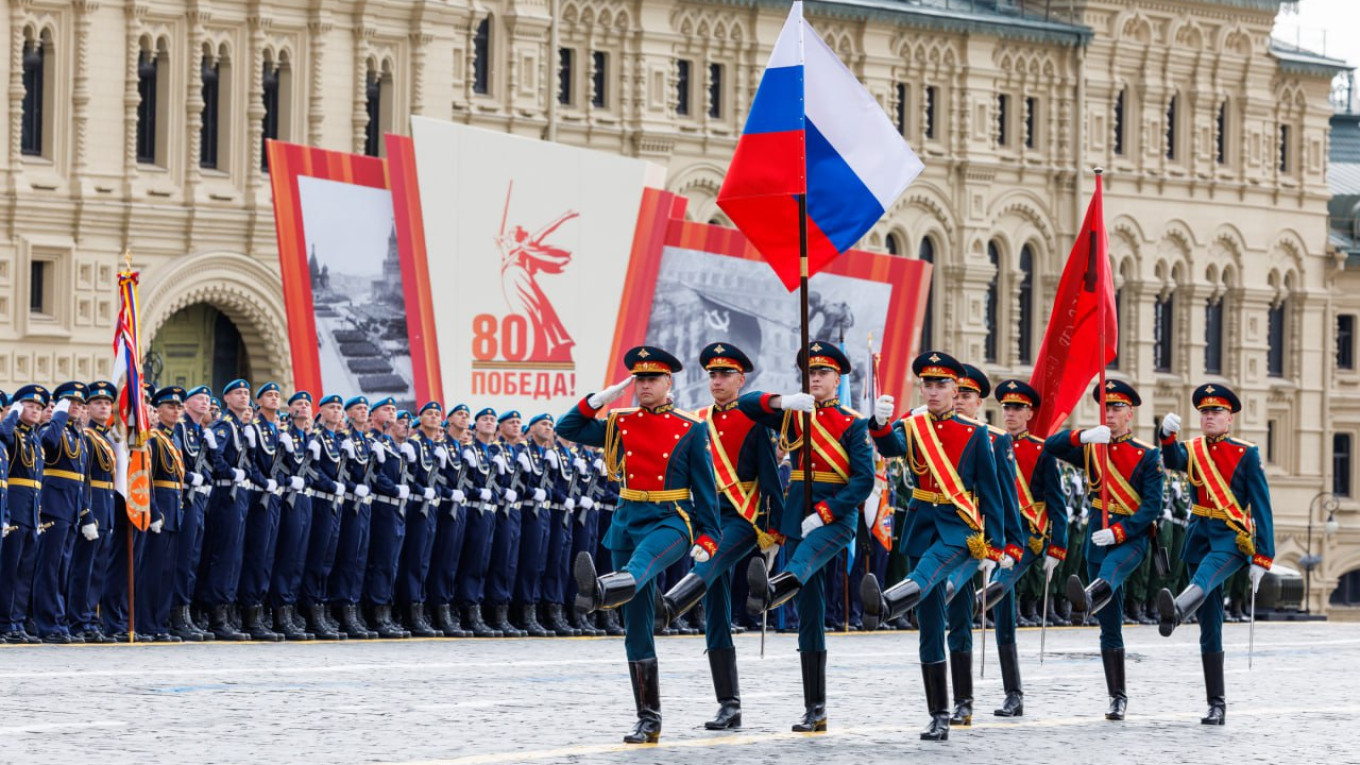
Cover picture: ChatGPT evisceration of this image of Russian soldiers marching: Russia Holds 80th Anniversary Victory Day Parade on Red Square, via The Moscow Times (9th May 2025). I asked ChatGPT to change the flag, banners, and uniforms to be evocative of the EU. The Russian drill looked a lot better than their fake EU counterparts, which you’d expect, to be fair.
- The UK, for example, has a foothold (about 4 million feet, to be accurate) in the EU Customs Union by dint of Northern Ireland and the 2021 Northern Ireland Protocol which aimed to resolve the problem of how to keep the UK out of the EU, while avoiding a border on the island of Ireland, and maintaining the integrity of the United Kingdom of Great Britain and Northern Ireland. The compromise was to fudge the last of these three requirements, to the consternation of Ulster Unionists. ↩︎
- PLEASE DON’T MAKE ME TALK ABOUT THIS… It’s too traumatic. ↩︎
- A construct which, as the timeline shows, disappeared when everything was subsumed in the EU in 2009 with the coming into force of the Lisbon Treaty. ↩︎
- My own included. Still, you have the appreciate the lower likelihood of being nuked. ↩︎
- It’s worth reminding ourselves that by the time of the US Civil War Virginia had been part of the United States of America only half as long (85 years) as it had been a British colony (170 years). ↩︎
- With the possible exception of North Korea, who have a special operations contingent which is about half as large again as the US SOCOM, but hardly likely to match the US for capability. ↩︎
- In total terms, with exchange rates to EU as of the time of writing. ↩︎
- There! I’m unconsciously an EU federalist. ↩︎


.svg)
Leave a Reply to Understanding EOD attire – Military Realism ReportCancel reply