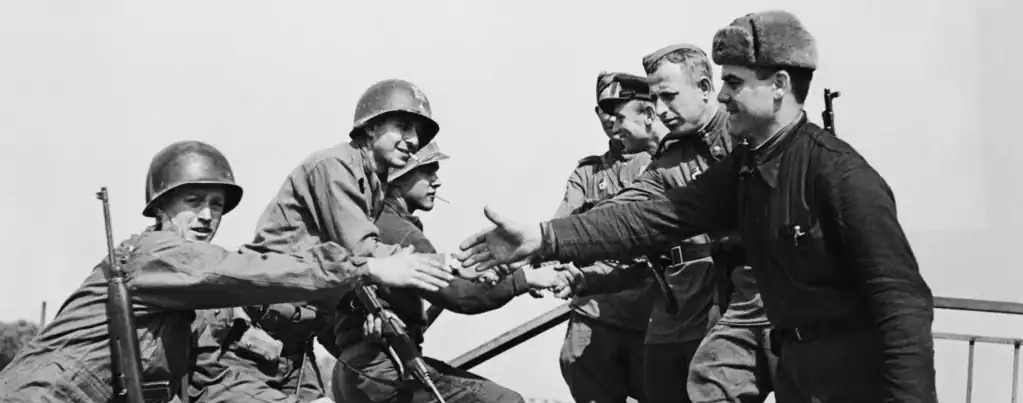
Why folks from different armies (often) get along.
Hi there and Happy Thursday. Today’s post is going to be a short one because last week’s holiday in the UK was inadvertently extended due to a medical emergency. Don’t worry, the Director and family1 are all present and correct now, but it was a rough week.
In a not unrelated note, crucial logistical and moral support for the operation was provided by some old comrades-in-arms with whom I soldiered several years ago. UK-based comrades, that is. But wait, I’m Irish. What’s more, I’m a proud Irish military veteran. I served in an organisation whose origin story goes back to fighting “the Brits.” Is it not a bit hypocritical for me to have served with said “Brits” and, to make matters worse, liked them?
No, of course not. Firstly, as the meme below captures, real personal interactions are a great way to break down the fake vitriol we might see online:

But today I want to focus on the military experience in particular. I’m going to argue that a feature of professional militaries is that they produce people who feel more comradeship with other military personnel, regardless of flag, creed, or colour.
The example of this that most of us are familiar with is the famous Christmas Truce of 1914 which occurred in many theatres and sectors of the front lines. Soldiers sang songs, exchanged souvenirs, lit candles on trees, and even played a few football matches in the horrendously ill-suited no-man’s land.
The Christmas truce has become an icon of the futility and waste of that war. Senior leadership on all sides deplored it and, for the most part successfully prevented similar truces for the rest of the war.
What’s going on here? There are three parts to this, and I’ll go through each in turn. The first is military socialisation, which turns civilians into soldiers and therefore gives them a commonality across nationality. The second is rank, status, and (by rough analogy) class, where enlisted soldiers from two opposing armies will have more in common with each other than with their own officers. Likewise, their own officers who, in earlier centuries, may even have spoken the same language as their enemies (French, for the most part).
The third part is mass mobilisation and total war, which is where the tide turns somewhat and we see a reversal in this “inter-military camaraderie.” War crimes and brutality are a characteristic of this kind of war: think of Germans against Russians in WWII.
Before we start, let me encourage you to subscribe to the blog using the link below. As always, I’d love to see your comments below, or you can contact me via webform here or email here. Finally, if you’ve enjoyed this post, please share it with a friend.
If you enjoy this blog and want to support it, please consider a donation. Keeping this blog going doesn’t cost much, but it isn’t free either, so any help would be very much appreciated👍
1. Military socialisation is universal
I remember during my officer training course getting a lecture from a graduate of France’s military academy, Saint-Cyr. I can’t recall what the purpose of the talk was, but I do recall when he was describing the calendar of the French officer training programme.
There was an academic block, and then something he called “meel-e-tary ‘ardening” (sorry to any French I’ve offended with my spelling out the accent). Military hardening! What a wonderful euphemism. We all chuckled to ourselves in the audience and the lecturer, not much older than us, chuckled back. We’ve never been to Saint-Cyr and he’s not undergone our training programme, but we all know exactly what this means.
But let me describe it for the benefit of those who don’t. More commonly known as military socialisation, or simply “boot camp”, this ‘ardening is the most important thing to happen to a soldier. It’s what turns a civilian into a soldier. I’ve written before about the importance of military socialisation and why boot camp is about so much more than fitness, so head there if you want to dive deeper on this.
What it means for the individual is that they remember their military socialisation long after the event. And, quite naturally, they’re interested and curious as to how other militaries do their version of socialisation. While this brutalisation might look all the same to a civilian, the soldier will appreciate the nuances, such as using medical dummies to accurately simulate the dead weight of carrying a casualty, or filling spent rocket launcher tubes with concrete to mimic the weight of a loaded and unfired version.
And, of course, any gathering of soldiers describing their basic training will devolve into some approximation of the Four Yorkshiremen sketch:
One-upmanship aside, however, soldiers are usually genuinely interested in how someone from another armed service trained. They have a shared experience, which leads to empathy and ultimately compassion.
I can attest to this effect from my own personal experience training and working with officers and NCOs from other countries. Focusing on the UK, I have learned a lot about outside perspectives on Irish history through my UK military friendships. I’ve also helped them understand Ireland and our own turbulent history a little better.
This stands in contrast to the simplistic tropes that are bandied about both here and in the UK, particularly since Brexit.
To give another example, here’s a bunch of veterans of the Falklands War—British and Argentine—climbing a mountain together as a gesture of reconciliation:
Meanwhile, on the football field:

You can also point to programs where US and Vietnamese veterans meet to search for the bodies of fallen comrades as examples of post-conflict camaraderie.
Although military socialisation is a crucial factor in explaining inter-military camaraderie, it’s not the only one. Time to dust off your Marxist Theory textbook and talk about class solidarity.
2. Social roles echo across national lines
The Christmas truce of WWI which I discussed above might have had something to do with the military socialisation I discussed above, but it’s unlikely given the low proportion of professional soldiers in the armies of France and Germany.
What’s more likely was that a pause in hostilities and opportunity to talk to the foe revealed to each that the other was just an ordinary working man like themselves. This was the decade that would see a socialist revolution in Russia and the emergence of soviets all over Europe, even in my own country. Many Germans had worked in England before the war and had the few words needed to hail their “fellows” and wish them a Merry Christmas.
This idea of the workers (i.e. ordinary soldiers) coming together in solidarity is reinforced by the reaction of the bosses (i.e. officers, senior ones in particular) who deplored these truces as a terrible repudiation of the fighting spirit they would need to defeat the enemy. I’ve written in more detail a few weeks back on the “officers and men” divide, and this might be a useful primer if you haven’t read it yet.
The irony of this is that the mostly aristocratic senior officers would have had far more in common with their opposite numbers on the other side than with their own soldiers. They may not have traded buttons or kicked a makeshift football, but they could have studied or travelled in each other’s countries before the war. Perhaps, if they were royal enough, they held honorary commands in regiments of the army they were not fighting as an enemy2.
If we were to wind the clock further back, to before the dawn of the nation state, then the idea of international camaraderie becomes the norm rather than the exception. True, religion is a sharp dividing line, but even that could be blurred in the right circumstances. In the 1812 Siege (or Sack) of Badajoz in Spain, a British force (including an Irish Regiment, the Connaught Rangers) went on a rampage of rape and pillage after taking the town and suffering heavy casualties in the effort.
The Irish were Catholics, but so were the Spanish civilians they brutalised. The French defenders inflicted the heavy casualties on the Irish troops, but they were left unharmed and simply taken as prisoners while the townsfolk bore the brunt of the troops’ savagery. And the British officers formed escort parties to convey aristocratic ladies to safety through the mob of soldiers, turning their sabres on their own troops to protect their class cousins.
In war as in peace, social roles dictate how soldiers engage with their counterparts on the opposite side (when they’re not shooting at them, that is). Give a man a cause to fight for, and this changes utterly, as we shall see next.
3. Mass mobilisation and total war changes things utterly
Any discussion of international military camaraderie quickly breaks down in certain situations and conflicts. For example, there was precious little inter-military goodwill between the German Wehrmacht of WWII and their Russian Red Army opponents. War crimes were the norm.
The Germans, at least officially, regarded the Russians as a lower class of human, and treated them as such during their invasion. The Russians, in turn, killed German prisoners or worked them to death in brutal prisoner of war camps.
The Japanese were notoriously cruel to their enemies as well. Even among the better “behaved” belligerents of WWII, it’s hard to find examples of the kind of camaraderie that was seen in Christmas 1914.
The obvious difference between these situations is the more total nature of the Second World War3. Large proportions of the male populations of each fighting country were recruited to fight a war that was, for some of them at least, existential. Of course, they still went through some sort of military socialisation as part of their training, albeit compressed in nature. This time, however, the shared experience would not be enough to form bonds with the enemy.
In the face of brutal treatment of prisoners, incessant propaganda, and enemy attacks on civilian targets, it’s no surprise that any respect or fondness for the enemy “as a soldier” is subsumed by hatred.
Conclusion: Soldiers have universal shared experiences
Soldiers go through the same formative experiences, by and large, no matter where they come from. This gives them an automatic bond. When you add in the complexities of class and professional role (e.g. officer or enlisted, or infantry vs. artillery, etc.), then you can appreciate that the bonds across nationalities can be stronger than bonds between military folk and civilians from their own country.
This breaks down, as we saw above, when a nation is engaged in total war and the normal rules of fair play in war go out the window.
Taken to extremes, this “soldierly solidarity” can be a very bad thing. The Italian Condottiere mercenaries of the Middle Ages were an extreme example. They would minimise risk to themselves and their employees (i.e. soldiers) and change allegiance as was expedient. They had no higher loyalty. Given that an army, at the best of times, draws food and resources from a population, this made them little more than parasitic protection rackets.
A recent article in the Financial Times talks about the “Hidden Curriculum” where new entrants to, say, the Civil Service learn not to tell tales on their superiors or peers. They learn to protect the institution rather than, for example, the public good. This is another downside of the strong camaraderie I discussed today. It’s a bigger topic than this, however, so I might come back to it again.
Until then, thanks for reading. That’s all for this week. What do you think? Please let me know in the comments below. As always, remember to subscribe if you haven’t already. Thanks again for reading.
Cover picture: U.S. and Soviet soldiers greet each other on the Elbe in Germany on April 25, 1945. From Radio Free Europe / Radio Liberty, April 25, 2020.
- The Director, Mrs Director, Mini Director, and Canine Chaos Agent. ↩︎
- Germany’s Kaiser Wilhelm II was an honorary Field Marshal in the British Army and Colonel-in-Chief of the 1st (Royal) Dragoons. ↩︎
- And, for that matter, the later stages of the First World War: there were no Christmas truces in 1915, 1916, or 1917. ↩︎


Leave a Reply