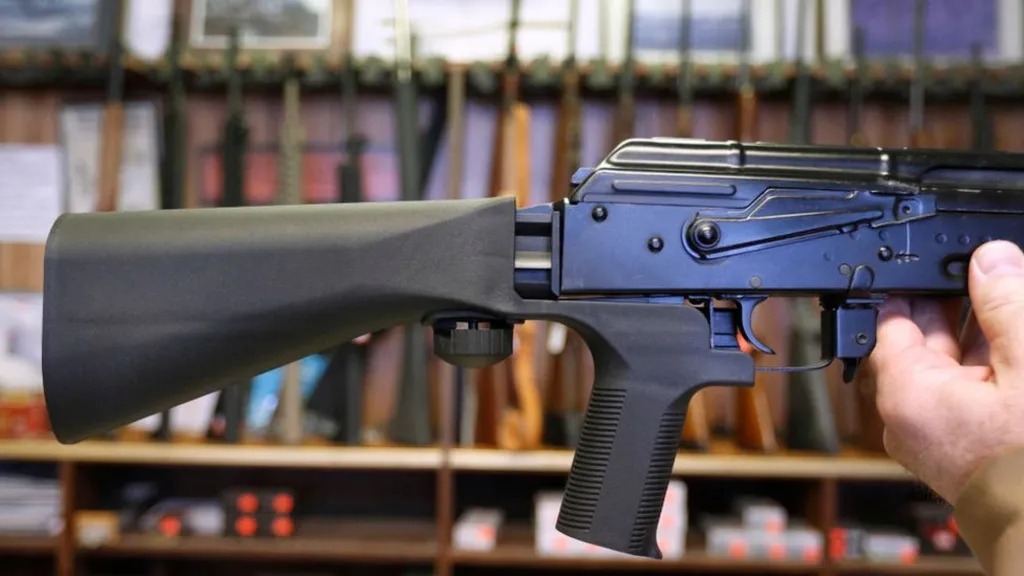
Bump stocks, forced reset triggers, and some more thoughts on automatic rifles.
Hello. I was planning to do a more science-fiction themed post this week but realised that I have a bit more to say about automatic weapons, and bump stocks in particular. I mentioned these devices in last week’s post on why firing on full auto is usually a bad idea, even though Hollywood loves it.
As I mentioned last week, bump stocks are an approximately legal (at least in most of the USA) way to get around the ban on fully automatic weapons for civilians:

These gadgets became notorious after they were implicated in the Las Vegas shooting of 2017 which killed 60 and wounded over 500 (and let’s take a moment to appreciate the enormity of this).
They were banned shortly afterward by President Trump’s administration, but that ban rested on a legal interpretation which was overturned by the US Supreme Court in 2024. Some states have their own bans on the devices, but they remain legal in Texas, Pennsylvania, Ohio, and at least thirty others.
I’d like to talk about bump stocks, but first we need to talk about semi-automatic fire itself and why it was such a military innovation. Once we’ve established that, then I’ll discuss how modern gun designers attain semi-auto fire from weapons which have full auto capability, both for tactical as well as legal reasons.
Then we’ll talk about bump stocks and how they get around the legal restrictions on full auto for civilians. We’ll also discuss the new kid on the block, forced reset triggers (FRTs), which do a similar thing. These two devices aim to engineer away part of the human control of a firearm, with mixed results.
I’ll end by giving my unsolicited opinion on regulation, not that it affects me in Ireland in the slightest. Thankfully.

Before we start, let me encourage you to subscribe to the blog using the link below. As always, I’d love to see your comments below, or you can contact me via webform here or email here. Finally, if you’ve enjoyed this post, please share it with a friend.
If you enjoy this blog and want to support it, please consider a donation. Keeping this blog going doesn’t cost much, but it isn’t free either, so any help would be very much appreciated👍
1. Semi-automatic fire was a real innovation
It’s hard to overstate what an important military development the self-loading rifle was. Machine guns, which are fully automatic, were in service in the First World War, but a soldier’s personal weapon was still a bolt-action rifle. This is a weapon where you need to do a manual “clunk-clunk” action between each shot. Like the chap below, albeit usually not so fast:

What’s happening in that four-part action? Let’s break it down:
- Rotate the bolt to unlock it so it can move backward after firing,
- Pull the bolt backward to automatically eject the fired cartridge case,
- Push the bold forward to load a fresh round from the magazine into the chamber,
- Rotate the bolt to lock it so it won’t move backward when you fire.
The self-loading firearm uses some of the gas or recoil energy of the fired round to automate the muscle power you see in the GIF above. I go into detail in my How Guns Work explainer, but suffice to say it involves more machinery at the back end.

The American M1 Garand was the first semi-automatic rifle to go into widespread service as the “default” soldier’s weapon. It gave the typical American infantry squad a more distributed form of effective fire than other armies had. Instead of eight guys with bolt action rifles and one with a big machine gun, the American squad had eight guys with semi-automatic rifles and one guy with a light machine gun. The result was more bang going downrange toward the enemy.
General George S. Patton called the Garand the “best battle implement ever devised,” and he knew a thing or two about battle implements, having designed his own type of sword.
Although militaries in decades to come would transition from semi-automatic only to rifles capable of fully automatic fire, the real game changer was that first move which got rid of the bolt action process. As I wrote last week, full auto has its uses, but these are secondary in contrast to the suppressing fire which is an infantry squad/section’s main “deliverable.”
Weapon design has arrived at the point where a modern military general issue rifle is capable of automatic fire, but troops are only trained to deploy it in occasional close-quarter engagements.
Civilians are a whole other matter. Whatever capability full auto brings to a soldier, it has no such utility for the target shooter, the hunter, the farmer, or even (and I realise I’m straying into dangerous territory here) the home defender. As a result, even countries with very lax attitudes to firearms have rules against letting civilians have full-auto weapons.

2. Semi-auto is achieved by taming a “real” gun
During my decade and a half in the military I fired too many live rounds to count, but can honestly say that fewer than a hundred came from full auto action1.
My rifle, in short, was a machine which rarely maxed out its potential. It kept the revs low, away from the red. Despite this, it was an effective tool in training and in operations. Which is why it’s so mind-boggling to see a country where a civilian can wander into a gun shop and come out with more or less the same thing for less than $2,000.

What’s the difference? The civilian version is unable to fire on full auto. You know, that capability that is extremely niche and brings as much downside as upside. That’s the difference.
How do manufacturers “enforce” this difference? After all, assault rifles are designed and engineered for the extreme environments of automatic fire (albeit not for sustained periods, as we discussed last week). Do they redesign the gun from the drawing board?
No. They take the military design and engineer a few changes to the body and trigger mechanism of the gun so it can’t fire multiple rounds on a single trigger pull. To be clear, this is very much a muzzling or taming of the weapon’s “natural” capabilities. Designers go to great lengths to ensure that gun owners can’t simply swap out a single part to remove this muzzle and get back to a full auto capability.
That’s it then, right? Civilians can have assault rifles, with all their killing power, but can’t let them run wild like the military can (but usually doesn’t). Clear? Well, not really. Because there are several controversial but common aftermarket gadgets which mimic the effect of automatic fire for the civilian enthusiast.
3. Bump stocks and other gadgets can mimic automatic fire
This is where bump stocks come in, the gadgets that prompted me to write this article in the first place. A bump stock (not to be confused with a meme stock, which is even more dangerous) is a gadget which replaces the stock (shoulder part) of your rifle as well as the pistol grip.
There’s a flexible compressive link between the stock and the rest of the gun so that the normal recoil action of the weapon moves the body of the gun (and attached trigger) back and forth relative to your stationary finger:

Yes, that’s just as dumb as it sounds. The shooter is sacrificing the stability of a firm shoulder just so they can loose off rounds as quickly as possible. It’s all the disadvantages of full auto, but worse.
As I mentioned above, bump stocks have been banned and un-banned in the last few years, but even while they were banned, technology moved on and gave us the next iteration in gaming the automatic weapon rules: the forced reset trigger (FRT).
This uses the moving parts of the weapon to quickly force the trigger forward after being pulled back. You see, normal semi-auto works like this:
- Pull the trigger back -> hammer hits firing pin hits base of round -> round fires -> weapon actions empty the cartridge case and load a fresh round
- Release the trigger forward -> reset the internal mechanism -> hammer ready to go again on next trigger pull
If you can speed up the second part so that it’s automated by the weapon, then all you need to do yourself is the first bit, continuously. In other words, just keep your finger to the rear, applying a bit more pressure than you would for full auto.
You can see how quick it is in the video below2. But remember, it’s definitely not full auto, as the guys here are at pains to point out. “Terminology is important.”
These devices, especially the FRT, can achieve something which looks and sounds very much like automatic fire. Some crucial differences remain, but the main issue I see with them is that they are mechanical workarounds to a mechanical imposition: a loophole.
By way of analogy, let’s forget about guns for a second and turn to our favourite asset bubble: artificial intelligence. I’m sure you’ve been following recent stories about scary so-called frontier AI models which escaped their sandbox test environments and hacked other companies without human knowledge. Scary stuff, right? Sounds like the kind of stuff you might want to regulate.
I know: let’s put a human in the loop. Sure, that slows things down, but it drastically reduces the chances of robo-cyber attacks. No-one wants those, right?
But what if you want to unleash your own frontier AI model. After all, the only thing that can stop a bad person with a rogue AI is a good person with a rogue AI. But you don’t want to break the law. And the law says you need a human in the loop. Luckily, the law doesn’t specify how old that human must be. Great, let’s get a baby to supervise the model. It’s perfect because they lack the fine motor skills to interfere with the AI’s actions.
Bump stocks are these baby humans in the loop. They give you the same danger and chaos as the real deal (full auto), but will even less control. FRTs might be a touch better, since they don’t disrupt proper grip as much. Maybe they’re like putting a Tamagotchi in the loop.
On that sorry note, I have a few finishing thoughts on how automatic weapons are regulated in the US.
Conclusion: My own two cents on regulation
Who am I to lecture the greatest country on Earth on how to run its gun laws? I’m just a guy on the internet. Indeed, sir. I see all you freedom-lovers out there. You are correct: mine are the ramblings of a woke Euro-trash libtard. Now, with that out of the way, let me lecture the greatest country on Earth on an aspect of its gun laws.
US law doesn’t let civilians own “machine guns”. What’s a machine gun?
The term “machine gun” means any weapon which shoots, is designed to shoot, or can be readily restored to shoot, automatically more than one shot, without manual reloading, by a single function of the trigger.
—The National Firearms Act of 1934
The controversies around bump stocks and FRTs lies in the interpretation of the above definition. Some (including the Supreme Court) would argue that each back-and-forth automatic resetting of the trigger is a separate “function of the trigger,” and so the things you’ve seen firing very quickly in videos above are not machine guns. Others contend that being able to do a single action with your finger fulfils the terms of the definition.
I won’t apologise for saying that I favour the second point of view. There’s no way that these things aren’t automatic weapons. Badly designed ones, for sure, but automatic weapons nonetheless. Having said that, I also think that the first interpretation is a valid reading of the law3 as it’s written. They could have written “by a single action of the firer,” instead of “single function of the trigger,” and we wouldn’t be having this debate.
In any case, the literal interpretation has won out and these devices are legal because they still don’t make the weapon into a “machine gun.” By this logic, you could design a piston-actuated mechanical finger which wraps around the trigger and is controlled by a button. When you hold the button, the mecha-finger flicks back and forth, pulling the trigger ten times per second. It’s genius, doesn’t conflict with the law, and definitely can’t be used for any other immoral purpose.
That’s a stupid idea, but it’s only marginally more stupid than the idea of bump stocks or FRTs: devices which mimic full auto fire, but with even less control. Really, at this point they should just accept that full auto is a “thing” and there’s no need for silly laws that give rise to such technological kludges.
But that’s my two cents. What do you think? Please let me know in the comments below. As always, remember to subscribe if you haven’t already. Thanks again for reading.
Cover picture: What are bump stocks? US Supreme Court lifts Trump-era ban on gun attachments, Brandon Drenon, BBC News (Jun 2024)
- Not including machine guns, although even here you tend to fire short bursts rather than holding the trigger down and spraying and praying. ↩︎
- The ATF (Bureau of Alcohol, Tobacco, Firearms and Explosives) may HATE that video, but I LOVE the clickbait of it all ↩︎
- I should caveat at this point, in case it wasn’t obvious, that I’m not a lawyer. ↩︎


Leave a Reply