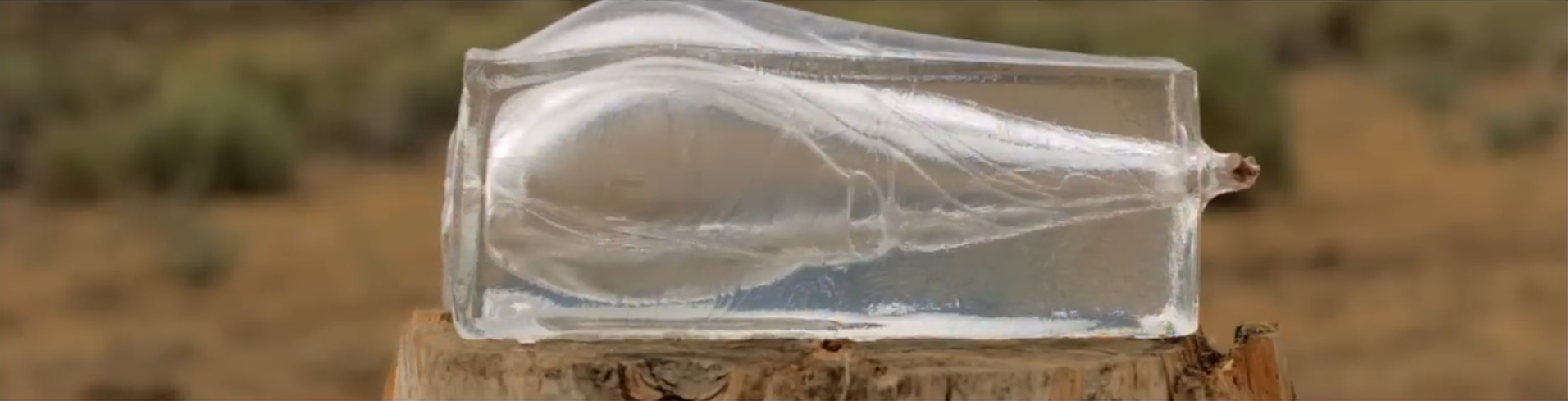
The myths and realities of wound ballistics.
Hello again to all my new and regular readers. Last week’s post was called “The importance of being alive,” but the original working title (which you can still see in the URL) was “The importance of not being shot.”1. We focused on tactical security as a part of military doctrine and drills last week, but I thought it might be useful this week to go into the gory (literally) details of what bullets do to human bodies. I’ll contrast the reality of gunshot wounds with the sanitised versions we see in video games and on TV.
Content warning: This post will talk about the effects of bullets on human bodies. I’ll try not to be graphic for the sake of it, but this is an unavoidably dark subject. If you’re not feeling in the headspace to deal with it, then take a knee and come back to it when you are (or skip it; I won’t be offended).
This will be the first in a series of posts on the topic of ballistics.

I’m starting a little bit back-to-front by talking about wound ballistics today, but this is a topic readers have specifically asked me to discuss, so here goes. I’m going to start today’s post by talking about the physical effects of bullets travelling through flesh. Then I’ll contrast some of these effects with what we see in films and video games. Finally, I’ll turn to first aid and advanced treatment of bullet wounds, again contrasting what we see on-screen with the reality.
As always, though, I’ll start with my usual encouragement: please subscribe using the link below if you haven’t done so already. You’ll get sent any new posts as soon as I publish them, and you’ll be helping me with my passion for bringing the nerdiest aspects of military life to your computer and phone screens. Please also “Like” and share this article on social media to the same end. Finally, do let me know what you think, whether you agree or disagree. The best way to do so is in the comments section below. Thanks, and enjoy today’s article.
If you enjoy this blog and want to support it, please consider a donation. Keeping this blog going doesn’t cost much, but it isn’t free either, so any help would be very much appreciated👍
Getting shot anywhere is bad news…
In the litany of obvious things I’ve said on this website, the above must rank fairly high. And yet the movie and video game industries would have you believe otherwise: that gunshot wounds can be no more than a minor nuisance (if you’re lucky and smart enough). The limbs and shoulders seem to be particularly resilient. If you get shot there, it’s a minor annoyance to be dealt with later:
Let’s take a look at the actual effects of a bullet on the human body, or at least on ballistics gel, which is the standard substitute used in tests. First, here’s a GIF of 5.56 mm (NATO standard rifle ammo):

Next, here’s a bunch of handgun hollow-point rounds, which are designed to cause maximum internal damage:
In the videos of bullet impact above, each second of video time is about six milliseconds of real time2. So, we can chart the journey of the bullet through the body in terms of seconds, and also use a bit of imagination to translate what’s happening in the gel into what’s happening in a human body:

- 0-1 milliseconds (ms): Bullet breaks the skin and enters the body. Suddenly the bullet is travelling through water (more or less) instead of air. Its spin still keeps it steady, but it can’t go very far in this environment. The heavy drag of the water acts on the tip of the bullet, pushing back against it. If the bullet has a hollow tip/point3, this will start to bulge open.
- 1-2 ms: The bullet feels the effect of the 1000x denser external medium. Its spin is no longer enough to keep it from tumbling, so it starts to rotate. At the same time, the drag forces of the water cause the hollow point to bulge into a mushroom shape. This increases drag even more, leading to more deformation and tumbling.
- 2-3 ms: The tumbling, possibly splayed-out bullet causes a bubble-like “temporary cavity” which pushes all other organs, blood vessels etc. away. Fragments of the bullet might break off and cause additional, smaller permanent cavities.
- 3-5 ms: As the bullet slows, it has less energy to keep pushing open the temporary cavity, which gets smaller as the bullet comes to its final resting position in the body.
- 5-15 ms: The temporary cavity collapses back and the displaced organs and blood vessels partially return. There is a permanent cavity which is smaller than the temporary one.
Fluid dynamics acts on different types of bullets in different ways, with corresponding effects on the wounds they inflict:

As you can see from the diagram above, bigger and faster bullets have a bigger and bloodier effect on human tissue. However, the biggest rounds can actually go through the target without leaving all of their energy inside, provided it is thin enough. The longer the round stays in the body, the more likely it is to yaw and thereby create an enlarged permanent and temporary cavity. E.g. for the 7.62 x 39 mm round, hitting a target less than ~25 cm from front to back would result in the round going through the target without leaving all its energy inside.
Every different type of bullet has a certain “effectiveness” against a corresponding target. The actual damage, or “effect” that a bullet will have against a particular target depends on a multitude of factors, including the target’s own physiological and psychological state. It’s difficult or even impossible to predict what the effect of a certain bullet will be, but we can talk about the effectiveness of particular bullets against particular targets. In other words, every gunshot wound will be unique, but with common characteristics. It’s much simpler in the world of video games and Hollywood, as we’ll see next.
…but films, TV, and games are a lot more forgiving
In contrast to real life, where the effect of a bullet depends on many factors, there’s a much simpler determinant at play in movies and TV, which I call the “Prominence/Morality Matrix”:

If you’re the main character and a goodie, then you’re virtually impervious to bullet wounds, or at most they are a minor inconvenience. If you’re a generic baddy henchman, then even the puniest bullet will tear through your body and create momentum out of thin air to hurl you backward to tumble over the nearest railing or balcony.
In video games, the effect is a lot more deterministic. Characters have a set number of “hit points”. Reach zero and you’re dead. Bullets take hit points off the character in a fully predictable way, and you can usually see this on-screen with the health bar:

There’s still some of the Hollywood bias in video games too, because main characters usually have way more hit points than mere henchmen. Baddies, however, sometimes have far more. The hit point allocation also depends on the difficulty setting. In video games, the headshot usually inflicts the maximum number of damage points, and other parts of the body attract fewer.
Hollywood also has a fixation with “headshots,” which are the mark of a very accomplished sniper, special agent, or assassin:
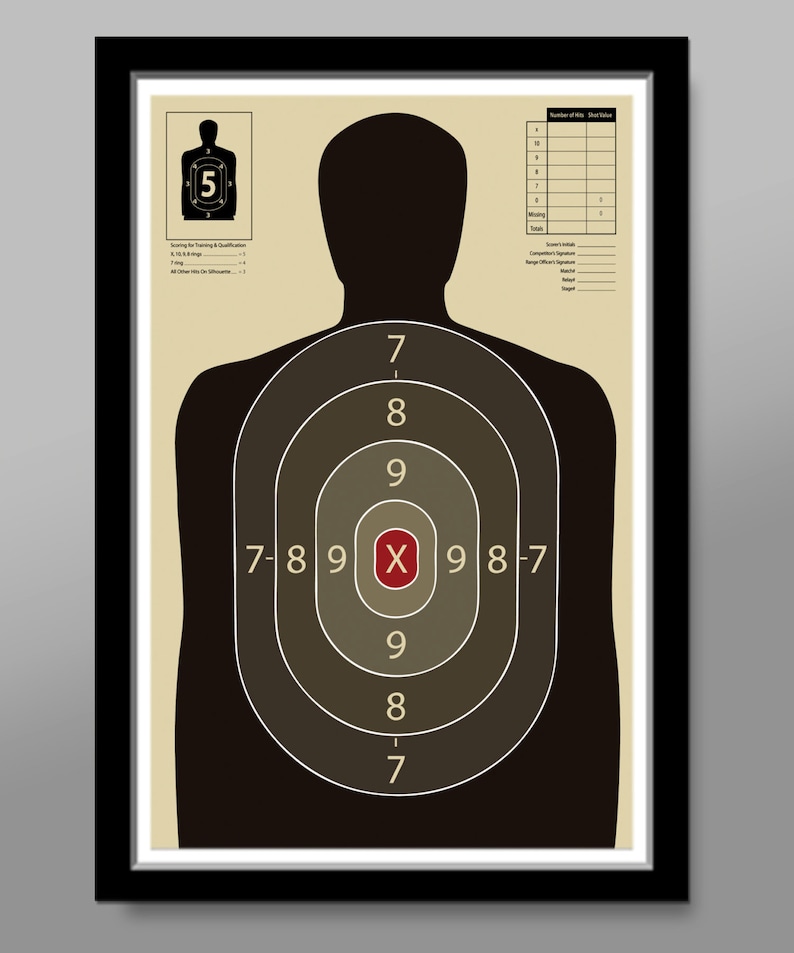
Obviously, the head is the worst place to be shot, but soldiers aren’t trained to aim at the target’s head. Why? Because it’s small and can move around unpredictably. It’s more reliable to aim at the target’s centre of mass (i.e. their chest), and marksmanship training targets follow this principle:
As we’ve seen above, the bullet’s effect on the body means that hits to the limbs or shoulders are still almost certainly going to leave big ol’ cavities in the body which are likely to cause incapacitation. A bullet to the thorax or abdomen (the most likely place to hit) is going to do even more damage.
Just because the cavity is “temporary,” by the way, does not mean it lacks wounding potential. The rapid displacement and return of organs and blood vessels can have catastrophic consequences for the target. There is a difference, however, between incapacitation now and incapacitation later. In the heat of battle, a target can suffer several gunshot wounds and keep going, so ammunition designers focus on achieving rapid incapacitation with one round, in a matter of seconds. Just because they can stay in the fight does not mean that they are unharmed.
First aid involves much more than health packs or makeshift bandages
If a gunshot wound doesn’t put you out of the fight immediately, it will do so after the fact, once the adrenaline has washed away but the pain has not. Fictional representations of gunshot wounds do not take account of this:

I don’t think anyone out there seriously thinks that walking over a first aid kit will instantly heal you, so pointing out the lack of realism in video games feels a bit “well, duh”. I doubt we actually want a realistic shooter. Moving on to movies, then, there’s a few common tropes around the treatment of gunshot wounds:
Taking out the bullet. This is not something you should do yourself, as it may do more harm than good. In fact, you shouldn’t ever remove something which has caused a penetrating injury. Leave this to the medical professionals, even if you’re James Bond.
Maintaining full range of motion. Even if you’re so high on adrenaline that you don’t notice the pain, you’re still going to run into mechanical problems. Cavitation caused by the bullet might have severed nerve connections, tendons, or fractured bones, all of which making it difficult or impossible to move (and shoot, and fight) as normal. Sorry Bruce.
A woman’s love. The hero is usually patched up by the love interest (regardless of her level of medical training). This gives him a chance to demonstrate his tolerance to pain, and her a chance to admire him for this. It’s the perfect meet-cute. Right? Somehow, I don’t think I would be at my most alluring after I’d been shot.
As the crowning example of what not to do, let’s look at Sylvester Stallone’s actions below in Rambo 3:
Oh dear. Don’t take out the fragment. Don’t try to cauterise the wound yourself without antiseptic. Definitely don’t use gunpowder to do this. In short: Don’t do what Donny Don’t Does.
Conclusion: Why wound?
Now that we’ve gotten a taster of the nasty ways that bullets affect human tissue, you might be wondering whether and why designers go to this effort to cause such pain and trauma with bullets. I won’t get into the moral question of whether or not guns, ammunition, or military operations are inherently bad. What I will say is that a designer of guns and ammunition, whether good, bad, or indifferent, has a desired outcome and engineers the tool to achieve that outcome.
What is that outcome? Weapon and ammunition design is all about delivering the maximum amount of energy to the target through each stage of ballistics, including wound ballistics:

Bullets need to carry their kinetic energy as far as possible, get through any protective armour, and then dump as much of that energy as possible into the target to cause incapacitation. Because that is the ultimate goal of any firefight: to incapacitate the target so that they no longer pose a threat. Ideally, we want this incapacitation to happen as quickly as possible. Depending on the circumstances, however, we will use different types of ammunition to achieve this:
| Scenario | Target considerations | Energy transfer considerations | Suitable ammunition types |
|---|---|---|---|
| Police engaging an armed criminal | Probably unarmoured, at close range, with high likelihood of innocent parties nearby | Prevent over-penetration (could cause collateral damage) | Hollow-point for rapid incapacitation at close range |
| Sniper engaging enemy soldiers | Long range, target protected by armour | High velocity to get bullet to target and to penetrate the armour | High-calibre, high-velocity, potentially armour-piercing |
| Hunter taking down large game | Unprotected, long range, single shot kill needed | High velocity to get bullet to target | High-velocity, potentially hollow-point to maximise wounding effect |
| Soldier engaging insurgents in a city | Probably unarmoured, at medium range | Hit target accurately, cause rapid incapacitation | Ball (i.e. “normal”) rifle ammunition4 |
What about suppression? I’ve written frequently in this blog about the importance of suppressing fire as part of standard infantry tactics. Modern manoeuvre warfare is all about using fire to keep the enemy’s head down so that your own forces can move under cover to a better position. The vast majority of rounds fired in anger never strike a human target—they pass overhead. The ability to suppress the enemy, however, is dependent on the threat they perceive from your firepower. So, your ammunition needs to be able to do its gruesome business at the target end for the enemy to take it seriously.
There you have it: when we strip back all the military doctrine and theory and drills and training, it’s all about wounding the enemy enough so that they’re no longer a threat. Firearms are one (but not the only) way of doing this, and they do it with a ruthless efficiency that we don’t really see in our movies, TV shows, or video games.
That’s all for this week folks, thanks for reading. As I mentioned at the top, I hope to do a series on ballistics, so watch this space for some articles about internal, intermediate, external, and terminal ballistics. As always, please “like” and share this on your social feeds if you’ve enjoyed it and subscribe using the link below if you haven’t already. Please also share your thoughts in the comments section below. See you next week!
Featured Image: 44 Magnum vs Gel Block, Bullet Theory Films. Via YouTube
- I hope you all chortled at the Oscar Wilde reference in my revised and current post title, because that’s the only reason I changed it. God, I do hate me sometimes. ↩︎
- This estimate comes from the video. In the full episode (here), the camera guy says he’s shooting at 5000 frames per second (FPS). Assuming the playback is at 30 FPS for us, this means each second of real time translates to about 167 seconds of slow-mo time. Or, to put it another way, each second of slow-mo time is about six milliseconds of real time. Or, each 1/6 seconds of slow-mo time is one millisecond of real time. I don’t know what the high-speed frame rate of the first 5.56 mm GIF was, but it looks about the same, so I won’t go down a rabbit hole of trying to figure it out. ↩︎
- Hollow point ammunition is forbidden for use by militaries, at least when the purpose of the hollow/flattened tip is to cause enhanced wounding. It’s a grey area that’s potentially exploited by some ammunition types, e.g. open-tip match (OTM). That’s a story for another day, as is the legality of hollow point ammunition. ↩︎
- Without going down the rabbit hole of the Hague Convention and the Law of Armed Conflict (see above), yes you could in theory use hollow-point ammunition for many military engagements where you need rapid incapacitation and are worried about collateral damage. However, you’re not allowed. ↩︎




Leave a Reply to Send in the troops – Military Realism ReportCancel reply