The strange world of intermediate ballistics.
How time has flown. I started Military Realism a year ago this week with an article marking the 80th anniversary of Operation Overlord (a.k.a. “D-Day.”). I never thought so many people would come here to see what I have to say every week about how the military is depicted in fiction. Thanks for your support! It means a lot to me. Please help me keep it going by liking, sharing, and subscribing (if you haven’t already—the link is below).
This week I’m going to continue my mini-series on ballistics and look at intermediate ballistics, which is a strange and often overlooked regime between the giants of internal and external ballistics:

Formally, intermediate ballistics (or transitional ballistics) is the study of projectiles from when they exit the muzzle (the front) of the gun until they overtake the muzzle shock waves and enter the normal atmosphere. It is not an exact science1, and it’s over quickly. It is still important: getting this bit wrong can mess up the bullet, the gun, and the firer.
I’ll start off this week’s post by explaining what intermediate/transitional ballistics is. Then I’ll go into the problems it brings the gun designer, namely aerodynamics, recoil, and noise. Along the way I’ll show you how Hollywood gets it wrong, usually quite understandably.
Before we start, let me sound my usual clarion call for support. If you like what you’re reading, please subscribe so that you’ll never miss a post. Please also like and share on your own socials to spread the word with potential new readers.
If you enjoy this blog and want to support it, please consider a donation. Keeping this blog going doesn’t cost much, but it isn’t free either, so any help would be very much appreciated👍
Intermediate ballistics is the messy transition between two stable regimes
As the diagram and the name imply, intermediate ballistics is a transitional phase between internal and external ballistics. Whereas internal and external ballistics and well-understood and predictable, intermediate ballistics is chaotic:

Intermediate ballistics is imprecise because it involves turbulent flow, which is inherently chaotic. It doesn’t last very long—a few hundred microseconds3 at most—but its effects can be significant for the projectile, the weapon, and the firer.
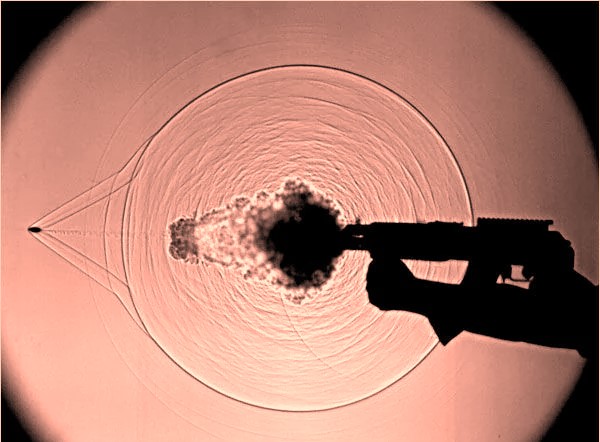
Schlieren photography4 gives us a way to observe the fast-moving gases and shock waves which define the intermediate ballistics region:

This is a Schlieren photo montage of a pistol bullet just after it exits the gun barrel. What, exactly, are we seeing in these pictures?
- Time dilation. The video is slowed down, obviously. It’s hard to say for sure, but I estimate this clip covers about 0.6 milliseconds and 250 mm of travel, or a slow-down factor of over 6,0005.
- Shock fronts. The sharp lines in the picture in front of and behind the bullet are the “fronts” of shock waves, i.e. the actual boundary where the air pressure changes suddenly. This sudden change in pressure is what defines a shock wave.
- Turbulent gas flow. Harder to see in the first image above, but clearer in the one below, is the swirling mass of gas which indicates turbulent fluid flow. Just like turbulence on a flight, turbulent flow is unpredictable by its nature.
Intermediate ballistics generates three problems for the gun designer
Problem 1: I need to design my bullets to fly backwards as well as forwards
When the bullet reaches the muzzle of the gun, the pent-up gases behind it still have a lot of energy. They jostle around it and rush past. You can see this most clearly in the AK-47 GIF above, within the first foot / 30 cm (and probably about 400 microseconds, or 0.4 milliseconds). The propellant gases move past the bullet (in fact, they completely obscure it) since they are travelling faster. This means that for a brief fraction of a millisecond, the bullet is flying backwards.
Let’s think about a bullet in normal flight, or an aeroplane, car, or anything aerodynamic. As it travels forward the (mostly) stationary air seems to move from front to back at the same speed as the object travels forward. If the object was stationary and the air moved at the same speed instead, this would have the same aerodynamic effect. This is the principle behind wind tunnels.

If, by the same logic, the air/gas is flowing past the bullet from back to front, then the bullet is flying backwards:

This is more than just of academic interest. The shape of the back of the bullet is slightly important when the bullet is flying forward, but extremely important when it’s flying backward. This can be a problem because of how bullets are made. Military bullets have a copper jacket covering the lead core, and the traditional way of putting on the jacket leaves a messy opening at the base:

The open-tip match (OTM) round improves “fly backward-ability” by putting on the jacket the other way around, with a more controlled manufacturing process:

Although this process greatly improves accuracy, militaries have been slow to adopt OTM rounds because of a belief (probably false, and certainly conservative) that their small hollow tip puts them in violation of the Hague Convention6, a point I touched on last week.
What does this have to do with the movies? Admittedly not much—bullet-jacketing techniques rarely feature strongly in any work of art—but it does bring in mind the brilliant opening sequence from Lord of War:
Problem 2: I have to figure out what to do about the recoil
If the plume of propellant gases looks a bit like a rocket to you, you’re on the right track. Just like a rocket, the gas coming out of a gun barrel will cause an equal and opposite reaction on the gun itself. We call this reaction “recoil,” and it can be quite dramatic, if you’re not prepared for it:
Recoil (and the need for accuracy) is why seeing action heroes “dual-wielding” weapons makes me roll my eyes. Even firing two pistols at once is stupid, let alone anything bigger and heavier:

What can a gun designer do about recoil? For starters, they can actually utilise it to make the gun work. I’m going to do a full explainer on how guns work some other day, but suffice to say now that most automatic weapons have a way of diverting some of the propellant gas energy back into the weapon to eject the fired cartridge case and load a new round into the barrel.

For the unused portion of the recoil energy, or for non-automatic guns, designers can reduce recoil in long-barrelled weapons with a special attachment on the end called a “muzzle brake”. This redirects the gases to the side or even backward. Obviously the shorter the barrel, the less ability there is to direct them backward without burning the firer:


Although these muzzle gases are mostly invisible, a realistic depiction in movies would have characters flinching away when their heads are close to another gun which is firing (or covering their ears, like we see in the photo above). The sound would also contribute to the flinch, and that’s what we’ll talk about next.
Problem 3: I can’t hear myself think over the noise!
The shock fronts on the Schlierin photographs above might look pretty, but they sound nasty. A shock wave results in a loud “bang,” since sound waves are pressure waves in air and a shock wave is a sharp increase in pressure7. That guns are loud is probably not news to you. But unless you’ve experienced it first-hand, you might not appreciate just how loud they are. In addition, bigger guns are louder still, to the extent that training becomes a serious health and safety challenge. Exposure to loud bangs brings three problems:
- Acoustic trauma. Sudden once-off damage to the eardrum, which may be temporary or permanent.
- Noise-induced hearing loss. Permanent progressive deafness from repeated exposure to loud noises.
- Mild traumatic brain injury. A more recent discovery, this is a scary loss of cognitive ability due to repeated blast waves hitting the soft and delicate tissues of the brain. It’s explained in more detail here.
Militaries, by and large, don’t want to cause unnecessary pain and suffering to their soldiers8, so will go to certain lengths to reduce the “loud noises” risk. Earplugs and earmuffs (what we used to call “double hearing protection”) or earmuffs alone (“single hearing protection”) bring noise levels below the danger line, depending on the weapon in question. The big problem, of course, is that it’s much harder to hear fire control orders and other instructions from your teammates. Imagine trying to do even the kind of simple section-level tactics I discussed a few weeks ago with your hearing ability significantly reduced. Or imagine that you’re patrolling and expecting “contact”9. Then you’d better have your hearing protection already in place, because you won’t get a chance once the bullets start flying. Good luck with any attempts at stealth when the whole team is operating with up to 30 dB10 hearing impairment.
One solution to this is active earmuffs, i.e. rugged noise-cancelling headphones which boost quiet sounds and muffle loud ones:

These can be very effective, but are just as awkward and uncomfortable as normal earmuffs. Every piece of equipment and armour which you make a soldier wear or carry involves a tradeoff between protection and mobility, and hearing protection is no different. Active earmuffs are yet another thing for a soldier to carry, keep spare batteries for, clean, maintain, break, or lose.
Silencers are another option. These can greatly reduce the bang caused by muzzle gases, which is good for the firer and their comrades close by. By passing muzzle gases through a series of baffles prior to entering the atmosphere, while leaving the bullet unhindered, they can also reduce recoil and turbulence, the two problems discussed above.

Contrary to their film depictions, however, silencers do nothing for the sonic boom of the bullet itself, or the mechanical noise of the gun, both of which can be significant. The “pfft” Hollywood noise à la John Wick below is pure fiction:
Still, silencers mitigate the problems of intermediate ballistics. Why aren’t they universal? We might discuss this in more detail in a future post dedicated to silencers, but suffice to say that they add complexity, weight, and a lot of additional maintenance to any gun. As we discussed above, any additional weight needs to be carefully “weighed” against the benefit it brings. This is, I think, the short answer to the reason why you don’t see them on general issue in the military.
While silencers are common in Hollywood (and usually portrayed unrealistically), you never see soldiers or action heroes wearing any sort of hearing protection in the movies. I’m willing to give a certain amount of leeway here: action heroes take risks no soldier ever would, and a bit of hearing loss down the line is hardly top of the list. Although when you think about franchise action heroes like James Bond’s exposure to millions of gunshots over the years, then some of his witty one-liners take on a new dimension:

There are plenty of loud weapons out there, but the loudest I ever fired were the 84mm recoilless rifles: the single-use AT-4 and the reusable Carl Gustaf Recoilless Rifle. Any time I fired or supervised the firing12 of these, I fastidiously wore double hearing protection, as per the regulations. And I still felt every decibel. This is why I absolutely cannot take the clips below seriously: these guys’ unprotected ears would be bleeding.

Conclusion: We design to minimise the energy lost
Last week we looked at wound ballistics and the design challenge of ammunition, which is getting the maximum amount of energy from the chemical propellant to the target. The same design challenge exists for every stage of ballistics:

Intermediate ballistics is a very short phase when compared with any of the others, especially external ballistics. It’s important, though, not just because of the relatively modest amounts of energy lost through turbulent flow, recoil, and sound. Each of these gives rise to a second-order reduction in the overall effectiveness of the bullet on the target:
- Turbulence upsets the trajectory of the bullet right at the outset of its travel, with small errors cascading into a large gap once the bullet reaches (or misses) the target.
- Recoil obviously changes the point of aim by applying a force through the gun. This has little or no effect on the bullet which has just left the barrel, but will have a significant effect on all subsequent rounds.
- Noise affects the shooter and their comrades and makes it harder to keep a steady point of aim.
Not an exact science, little understood, and often ignored. Welcome to intermediate or transitional ballistics. It’s messy because it’s the interface where two predictable but very different environments meet: the intricate and tight internal combustion engine of the gun barrel and the vast open-ness of the atmosphere. Gun designers will never fully understand the chaotic interplay of fluid and shock physics that happens here, but they still need to study it and attempt to make things a little bit better for the person firing the gun.
That’s all for this week. We might continue our ballistics series next week, or I might take a little break and do something different. I haven’t decided yet. Thanks for reading, and please like and share this with military-minded people like your good selves. If you haven’t subscribed yet, you can use the link below and never miss a post. Finally, do let me know your own thoughts in the comments below. Thanks!
Featured Image: Schlieren image of an AK47 shot with some lovely shocks on the leading and trailing edges of the bullet, from u/alex9831 via Reddit
- These aren’t my words, but those of Carlucci and Jacobson (titans of the ballistics world). ↩︎
- Well, according to the prompt I fed it: “Can you make me a picture please? I want it to be two staid, respectable, distinguished professor-types in a library, both frowning at an upstart mad-scientist type with zany hair and a labcoat. The mad scientist is in between the two of them. They all should have visible nametags. The first old professor is “Internal Ballistics”. The second is “External Ballistics,” and the scientist is “Intermediate Ballistics). Context: this is a metaphor.” ↩︎
- Millionths of a second. ↩︎
- We’ve seen Schlieren imagery on the blog before. It uses the principle that a moving fluid changes its optical properties, and these changes can be visualised using special equipment to make visible the invisible. ↩︎
- I’m assuming that the round is 9 mm in diameter and has a muzzle velocity of roughly 400 m/s. The duration of the animation is 4 seconds. ↩︎
- In short, the reason it’s probably not a violation is that the Hague Convention specifically bans ammunition which has a hollow point which is designed for and results in an increased wounding effect. OTM’s hollow point is a consequence of the manufacturing process, which in turn is optimised for greater accuracy, not increased wounding effect. In addition, the small open tip of OTM is quite different to purpose-designed hollow point ammunition, and studies suggest that its increased wounding effect is not significant, especially when compared to “traditional” FMJ rounds which tend to fragment inside the target. ↩︎
- Aside from gunshots, the very same phenomenon could be seen (heard) with Concorde, or indeed any supersonic aircraft. This is/was one of the problems with supersonic passenger flight: you can’t fly over built-up areas, because the shock wave is so loud. ↩︎
- “Are you high?” —every soldier ever. ↩︎
- This is a lovely military euphemism for “getting shot at by the enemy.” ↩︎
- dB = decibel (one tenth of a “bel”, but you never hear people talk about “bels”). Decibels are a funny unit. The bel is logarithmic, which means that each bel (or ten decibels) is an order of magnitude difference. 60 dB is ten times louder than 50 dB, which in turn is ten times louder than 40 dB, and so on. So the 30 dB sound intensity reduction from earmuffs is actually 10 x 10 x 10 or 1,000 times quieter. Wow! But our ears and brains have evolved to hear a wide range of sound intensities, so we don’t actually perceive 30 dB as being 1,000 times quieter. ↩︎
- I’m not singling out the USA for sneering (although you guys make it so easy sometimes). Silly and all as tactical flashes are, at least they make some kind of sense for a flag like Old Glory here which is recognisable in black and white. Likewise the Union Jack, Canadian flag, Chinese, Spanish, etc. What is utterly ridiculous is when soldiers from a country with a tricolour flag buy these velcro patches. I’m looking at you, France, Italy, and even (sigh) my own dear Ireland. ↩︎
- Firing these weapons was loud. Supervising was louder, but being the No. 2 for the Carl Gustaf was the worst of all. The No. 2’s job is the load the ammo and then look behind (with your head basically resting on the barrel) to ensure the back-blast area is clear. This means that the No. 2 doesn’t know exactly when the No. 1 is going to pull the trigger, so the chest-thumping bang will take them by surprise. ↩︎


.jpg)

Leave a Reply